
This article contains affiliate links. If you buy through them, MyrinNew.com may earn a commission at no extra cost to you.
🕒 4 min read
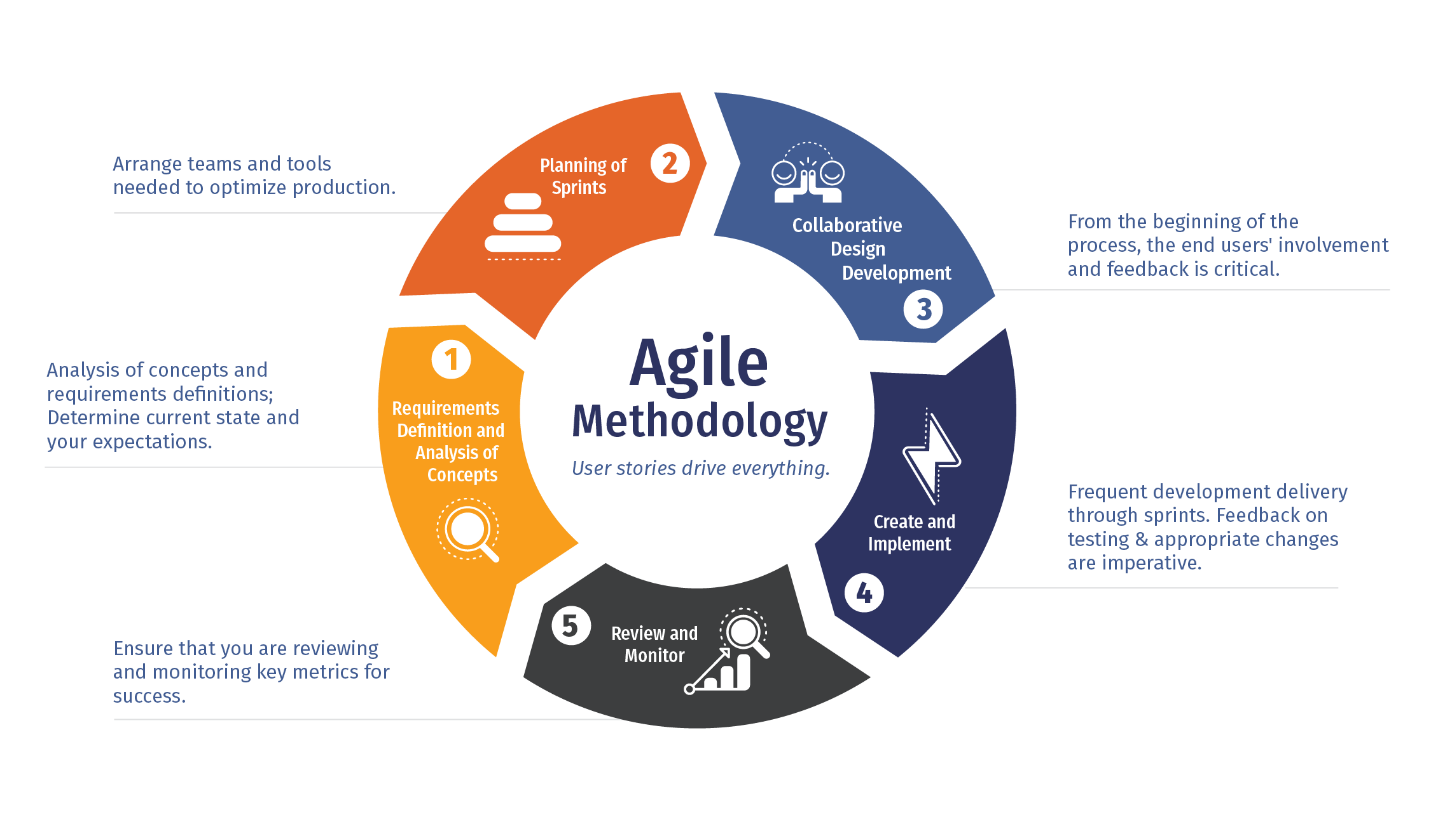
Agile is an approach to developing software based on values and principles for collaboration, useful delivery, and adapting to change. It is not one prescribed project method. Scrum is a specific framework that can support an Agile approach. A team can hold daily meetings and still fail to work in an Agile way if it cannot learn from users or change its decisions.
What “Agile methodology” usually means
People often use “Agile methodology” as a convenient umbrella term. The original Manifesto for Agile Software Development expresses four values and points to twelve principles. It emphasizes people working together, useful software, customer collaboration, and responsiveness while acknowledging value in processes, documentation, contracts, and plans.
The practical distinction is between a direction and a procedure. Values help a team choose between competing priorities. A method or framework supplies more specific structures. Confusing the two encourages teams to mistake compliance with a meeting schedule for evidence that they are learning or delivering value.
Affiliate pick: tech accessories

Belkin US
Belkin BoostCharge Pro 2-in-1 Wireless Charging Pad with Official MagSafe Charging 15W, Black
"BOOSTCHARGE PRO 2-IN-1 PAD WITH MAGSAFE BLACK"," | Belkin BoostCharge Pro 2-in-1 Wireless Charging Pad with Official MagSafe Charging 15W, Black
$44.99
$79.99
Price as of October 27, 2026
Is Agile a framework, a methodology, or a mindset?
For a precise conversation, describe Agile as the values-and-principles umbrella, then name the actual framework or methods in use. The 2020 Scrum Guide explicitly defines Scrum as a lightweight framework for complex problems. Scrum includes accountabilities, events, and artifacts; the manifesto does not prescribe that same structure.
| Term | Useful distinction |
|---|---|
| Agile | Values and principles that guide how a team develops and adapts |
| Scrum | A defined framework with specific accountabilities, events, and artifacts |
| A team’s working practices | Its concrete approach to testing, deployment, design, documentation, and collaboration |
A concrete example: changing an order workflow
Consider a hypothetical business that wants staff to resolve incomplete orders more easily. Instead of building every proposed feature before anyone can try it, the team chooses a small outcome: identify an order’s missing information and let an operator request the correction.
The team defines what success looks like, implements a usable slice, tests it, and asks actual operators to try it. Their feedback may reveal that the missing-information label is unclear or that an existing system already contains part of the answer. The next decision follows that evidence.
This example is not a claim about a measured client project. It illustrates how short feedback cycles can reduce the distance between an assumption and a useful correction.
Agile does not mean planning less carefully
A team still needs a purpose, a budget boundary, architectural decisions, and an understanding of risks. Adaptability means revising a plan when evidence changes, not pretending that a plan was unnecessary.
Affiliate pick: workspace accessories

Belkin US
3.1 USB-C to USB-C Data Transfer Charging Cable | Belkin, Black
$(document).ready(function(){ $(\"#usb_c_pencil-banr\").load(\"/resources/static-pages/belkin-usb-c.html #us\");$(\"#usb_c_cable_finder\").load(\"/resources/static-pages/belkin-usb-c_cable_finder.html #us\"); }); THE ULTIMATE USB CONNECTIONThe Belkin 3.1 USB-C to USB-C Data Transfer Charging Cable allows you to experience up to 10 Gbps transfer speeds,…
$24.99
$29.99
Price as of October 27, 2026
Some commitments also cannot be treated as casual experiments. Security controls, legal obligations, and dependencies on external systems may require deliberate analysis before a release. An iterative approach should expose those constraints early rather than using speed as a reason to ignore them.
How to tell whether the approach is helping
Ask questions about observable work rather than labels. Can a user try something useful? Does the team know which assumption it is testing? Can it explain why priorities changed? Are defects and blocked dependencies visible? Does feedback alter the next decision?
The Scrum Guide describes transparency, inspection, and adaptation as central to its approach. In practice, a board or status report is useful only when it helps people make a better decision. Moving cards across a screen without resolving uncertainty is activity rather than progress.
Where teams commonly go wrong
- Ritual without purpose: meetings continue, but no one can identify the decision they support.
- Output without usability: many tasks are completed, but a user cannot finish the intended job.
- Change without accountability: priorities move frequently without an owner or explanation.
- Speed without verification: a release is called complete before anyone checks whether it works.
Start by correcting one of these problems in a bounded workflow. A team does not need to announce a transformation before it can improve the way it learns.
Further reading
Read the original manifesto and Scrum Guide, then compare their definitions with the language used on your project. For a related practical exercise, explore Business Logic and define one useful outcome before choosing an automation tool.
Revised October 23, 2026 with AI assistance. The workflow example is illustrative. Definitions are linked to the original sources; no client results or productivity gains are claimed.